Interwiss - Bureau of Interdisciplinary SciencesDr. Michael Harder

      Deutsch
      English

Interdisciplinary Sciences
for a Complex World

The task of our bureau is to bring together the findings from different sciences and thus generate new knowledge that can help us better understand the crises and complexity of our modern world and find solutions on how to deal with them.

Physiconomics

In my search for solutions to the economic crises that constantly unsettle us, I came across a hitherto hardly studied borderline area between physics and economics, which I call physiconomics (composed of „physics“ and „economics“).
Physiconomics combines elements of „process physics“ or „physics of complex systems“, „game theory“ and „evolution theory (Darwinism)“ with economic questions. The increase in knowledge is enormous: Not only do the errors of our outdated economics and our economic system finally become clear, but clear recommendations can also be made as to the direction in which a new, more sustainable economics must develop, which takes into account the system boundaries of our earth. This is a new interdisciplinary science, which - unlike Econophysics - can provide elementary insights into the interrelationships and backgrounds of economic crises.

One example is the discovery of the „paradox of the rules of the game of economics“, which has so far been overlooked by economics: in systems with limited resources, the rules of the game are completely reversed in the saturation phase with further growth. There is a tipping point here, which occurred about 20 years ago (around the year 2000). The same strategies that previously generated even more prosperity are now endangering the overall economic and ecological system and thus this prosperity. In line with this, the system structure changed massively. A relatively stable system with limited complexity became an unstable one with high complexity (black box theory).
Old structures have long since disintegrated, the old patterns of management and control no longer work. In addition, together with the economization and financialization of our society and the still valid growth dogma resulting from the debt-money system, different scenarios are emerging that can lead to inflation or collapse.

The consequences for the decision-making capabilities of business (and political) leaders are massive. For the last 20 years or so, it has been virtually impossible to commit to long-term goals and to strategies for achieving them. Instead, set goals and their possibilities have to be re-examined at intervals and under intensive observation of the changing environment and the knowledge gained. For companies, two additional strategies are becoming essential for survival: Strategies to increase resilience and to strengthen innovation capabilities. Among other things, workshops on resilience and radical innovation were held for this purpose.

See Also

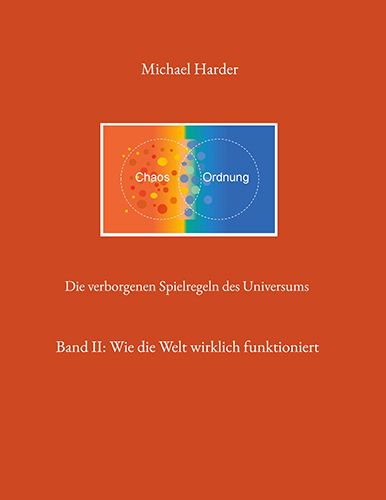
The hidden rules of the universe

Volume II: How the world really works

Read more.

Physiconomics

On the physics of economics.

Read more.
The hidden rules of the universe:
What is life? What rules of the game has nature provided for our world and our lives? And what does this have to do with all the crises we are currently experiencing?

In his search, the author comes across the four laws of time, with which at the same time a fundamental dualism openly appears. It is the dualism of order and chaos that leads into a world in which logic and provability take a back seat. It is now completely different, namely the rules of the game of complex systems, around which physics likes to give a wide berth, but which determine and shape the course and the liveliness of the world and thus all our lives. And only when we finally recognize and accept these rules of nature will we be able to understand and deal with the crises and complexity of the modern world.

Because that is what it is all about now: if we want to preserve our way of life, we urgently need to find out how the world really works.

256 pages, ISBN 978-3755767220
BoD, Norderstedt, 2022
x
Einstein's errors: the discovery of space and time.
420 pages, ISBN 978-3837092608
BoD, Norderstedt, 2010, €26.80
x
Physiconomics: On the Physics of Economics
256 pages, ISBN 978-3739217796
BoD, Norderstedt, 2015, €14.80
x
The Hidden Rules of the Universe. Volume I: What the world is really made of.
216 pages, ISBN 978-3750470408
BoD, Norderstedt, 2020, 12,99 €.
Notes about this book

After the publication of the 4th revised edition of "Einstein's Errors" in 2010, I have often been asked to write a version that is also more understandable for laymen. Prompted by the content and success of the book "Physiconomics" (2015), which deals with the crises and future prospects of our economy in a way that everyone can understand more easily, however, something else came up. I was faced with the task of not only revisiting "Einstein's Errors" and my criticism of special relativity, but more importantly of putting physics and many other parts of natural science into a larger context. As I will show you in this book, this is urgently needed. We need to find out as soon as possible how the world really works.

For this I begin in this volume I with the question of what our world consists of, because even that is not clarified until today. In the center of this popular-scientific book therefore the discovery stands, that the world obviously does not consist of space and time, but of a field of action quanta, which includes space and time. It would not only explain the dynamics of our universe but means a completely new foundation for the known physics. I call this part matrix theory.

Dr. Michael Harder, in October 2020

x
Quantum gravity: The Planck quantum as the origin of the general theory of relativity.
One of the major unresolved gaps in our knowledge of the physical world is the question of the compatibility of Einstein's general theory of relativity (ART) and quantum theory. The current search for answers in physics leads to the established research field of quantum gravity, where different doctrines compete with each other.

This research report now describes the working methods and findings of a scientist who, free from the university discipline of thought, brings together findings from various fields of knowledge. As the author shows, the search for an answer goes far beyond the actual topic. For the path to a solution inevitably leads via the great questions of time, such as the hitherto unknown mechanisms of time dilation and the tripartite division of time into past, present and future.

The report shows how an interdisciplinary combination of long-established knowledge leads to the abandonment of the model of a spacetime continuum in favor of a quantized scalar field of quanta of action. The most astonishing result of this new theory, called matrix theory, is the realization that Planck's quantum of action is not only the basis of quantum physics, but that this quantum is also the origin of Einstein's general theory of relativity! This makes Planck's quantum the link between ART and quantum physics. Many other proposed solutions to fundamental questions of physics, such as the question of the nature of the Higgs field and the Big Bang theory, which the matrix theory delivers as if in one fell swoop, give rise to the hope that something fundamental may have been found here that needs to be pursued further.

56 pages, ISBN 978-3769313642
BoD, Norderstedt, 2024, €8.99
x