Interwiss - Bureau of Interdisciplinary SciencesDr. Michael Harder

      Deutsch
      English

Interdisciplinary Sciences
for a Complex World

The task of our bureau is to bring together the findings from different sciences and thus generate new knowledge that can help us better understand the crises and complexity of our modern world and find solutions on how to deal with them.

About the rules of nature that govern our lives

It is easier to succeed with the laws of nature than against them.

If we want to know how the world really works and what laws nature lays down for our lives and our social systems, physics in its present form is of only limited help. And economics also reveals major gaps here.
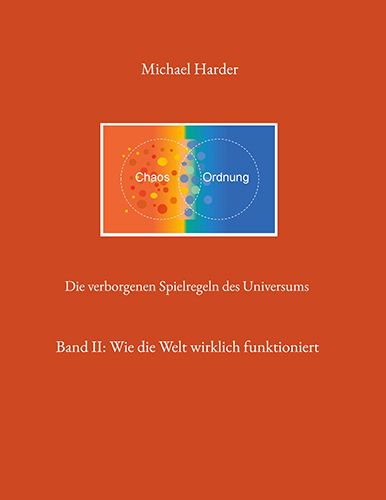
In the search for how the dynamics and complexity of our world works, i.e. all that actually determines our lives in everyday life, my interdisciplinary research showed that there is apparently not only 1 principle at work in the world, but that there are 2 principles that challenge us. Complementary principles of order and chaos - also called hierarchical and heterarchical principles or yin-yang principles - determine according to this the dynamics and complexity of our world (see figure). The monistic world view thus becomes a dualistic one.

And, as the mathematician Gödel already showed almost 100 years ago, the world consists systemically of several logical islands which are separated by undecidabilities and may even contradict each other, paradoxes are therefore allowed (see figure). So the world is structured differently than we would like it to be ... and thus not consistently logical. For scientific research at universities this is a big problem, because publications are based almost exclusively on logics of a single island and overall pictures with undecidabilities and possible contradictions are not in demand or the research is quickly overwhelmed with it. Decisions from the point of view of a single island, however, are very dangerous, as can be seen from the CO2 problem and Covid-19 strategies.
So we have to learn to think systemically, especially since the architecture of the system we live in has completely changed since the „tipping point“ about 20 years ago - something that was hardly noticed in economics and politics. With far-reaching consequences (see also Physiconomics). As a consequence of this tipping point, we now live in an increasingly nonlinear, highly complex and highly unstable system. It is therefore necessary to deal more intensively with chaos theory and complexities and also to research which functions stabilize complex systems and which can also cause them to collapse. In order to then come across the elementary law of nature, the various facets of evolution. From my point of view, it is the law that connects all sciences. And it is the basis for an insight from mathematics, for game theory.
These interdisciplinary insights are the tool I use to try to better analyze and understand real and potential crises from an overall perspective and to deal with them more successfully in lectures and consulting sessions with decision-makers from the business world.

See Also

The hidden rules of the universe

Volume II: How the world really works

Read more.

Physiconomics

On the physics of economics.

Read more.
The hidden rules of the universe:
What is life? What rules of the game has nature provided for our world and our lives? And what does this have to do with all the crises we are currently experiencing?

In his search, the author comes across the four laws of time, with which at the same time a fundamental dualism openly appears. It is the dualism of order and chaos that leads into a world in which logic and provability take a back seat. It is now completely different, namely the rules of the game of complex systems, around which physics likes to give a wide berth, but which determine and shape the course and the liveliness of the world and thus all our lives. And only when we finally recognize and accept these rules of nature will we be able to understand and deal with the crises and complexity of the modern world.

Because that is what it is all about now: if we want to preserve our way of life, we urgently need to find out how the world really works.

256 pages, ISBN 978-3755767220
BoD, Norderstedt, 2022
x
Einstein's errors: the discovery of space and time.
420 pages, ISBN 978-3837092608
BoD, Norderstedt, 2010, €26.80
x
Physiconomics: On the Physics of Economics
256 pages, ISBN 978-3739217796
BoD, Norderstedt, 2015, €14.80
x
The Hidden Rules of the Universe. Volume I: What the world is really made of.
216 pages, ISBN 978-3750470408
BoD, Norderstedt, 2020, 12,99 €.
Notes about this book

After the publication of the 4th revised edition of "Einstein's Errors" in 2010, I have often been asked to write a version that is also more understandable for laymen. Prompted by the content and success of the book "Physiconomics" (2015), which deals with the crises and future prospects of our economy in a way that everyone can understand more easily, however, something else came up. I was faced with the task of not only revisiting "Einstein's Errors" and my criticism of special relativity, but more importantly of putting physics and many other parts of natural science into a larger context. As I will show you in this book, this is urgently needed. We need to find out as soon as possible how the world really works.

For this I begin in this volume I with the question of what our world consists of, because even that is not clarified until today. In the center of this popular-scientific book therefore the discovery stands, that the world obviously does not consist of space and time, but of a field of action quanta, which includes space and time. It would not only explain the dynamics of our universe but means a completely new foundation for the known physics. I call this part matrix theory.

Dr. Michael Harder, in October 2020

x
Quantum gravity: The Planck quantum as the origin of the general theory of relativity.
One of the major unresolved gaps in our knowledge of the physical world is the question of the compatibility of Einstein's general theory of relativity (ART) and quantum theory. The current search for answers in physics leads to the established research field of quantum gravity, where different doctrines compete with each other.

This research report now describes the working methods and findings of a scientist who, free from the university discipline of thought, brings together findings from various fields of knowledge. As the author shows, the search for an answer goes far beyond the actual topic. For the path to a solution inevitably leads via the great questions of time, such as the hitherto unknown mechanisms of time dilation and the tripartite division of time into past, present and future.

The report shows how an interdisciplinary combination of long-established knowledge leads to the abandonment of the model of a spacetime continuum in favor of a quantized scalar field of quanta of action. The most astonishing result of this new theory, called matrix theory, is the realization that Planck's quantum of action is not only the basis of quantum physics, but that this quantum is also the origin of Einstein's general theory of relativity! This makes Planck's quantum the link between ART and quantum physics. Many other proposed solutions to fundamental questions of physics, such as the question of the nature of the Higgs field and the Big Bang theory, which the matrix theory delivers as if in one fell swoop, give rise to the hope that something fundamental may have been found here that needs to be pursued further.

56 pages, ISBN 978-3769313642
BoD, Norderstedt, 2024, €8.99
x